Understanding Price Charts and Candlesticks
Why Charts Matter
A price chart is a visual representation of an instrument's price over time. It's the single most important tool in a trader's toolkit. While you could trade purely off numbers, charts let your brain instantly recognize patterns, trends, and key levels that would be invisible in a spreadsheet.
Types of Charts
Line Charts
The simplest chart type — just a line connecting closing prices over time. Good for seeing the big picture but lacks detail.
Bar Charts (OHLC)
Each bar shows four data points for a time period:
- Open: where the price started
- High: the highest price reached
- Low: the lowest price reached
- Close: where the price ended
Candlestick Charts (Most Popular)
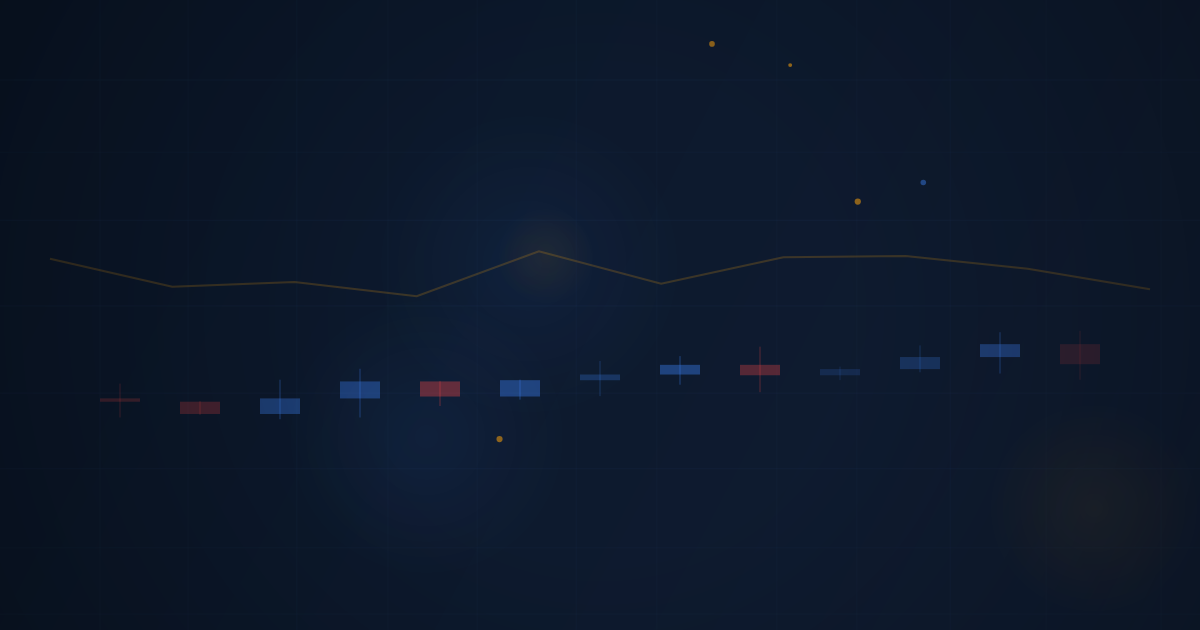
Candlestick charts display the same OHLC data as bar charts but in a more visual format. Each "candle" has:
- Body: the thick part between the open and close
- Wicks (shadows): thin lines extending above and below the body showing the high and low
- Color: green (or white) means the close was higher than the open — bullish. Red (or black) means the close was lower than the open — bearish.
Reading a Candlestick
Imagine a 1-hour candle for EUR/USD:
- Open: 1.1000 (where price was at the start of the hour)
- High: 1.1025 (highest price during the hour)
- Low: 1.0990 (lowest price during the hour)
- Close: 1.1020 (where price was at the end of the hour)
Since the close (1.1020) is higher than the open (1.1000), this would be a green candle with a body from 1.1000 to 1.1020, an upper wick to 1.1025, and a lower wick to 1.0990.
Timeframes
The same instrument can be viewed on different timeframes:
- 1-minute (M1): Each candle = 1 minute of price action. Very detailed, very noisy.
- 5-minute (M5): Common for day traders and scalpers.
- 15-minute (M15): Good balance of detail and clarity.
- 1-hour (H1): Standard for intraday swing analysis.
- 4-hour (H4): Shows multi-day trends.
- Daily (D1): Each candle = one full trading day. Great for trend identification.
- Weekly (W1): Big-picture view for long-term trends.
Pro tip: Most successful traders use multiple timeframes. They might identify the trend on the daily chart, look for entry zones on the 1-hour chart, and time their entries on the 5-minute chart. This is called top-down analysis.
What Charts Tell You
Charts reveal several important things at a glance:
- Trend direction: Is price generally going up, down, or sideways?
- Momentum: Are the candles getting bigger (stronger moves) or smaller (weakening)?
- Key levels: Where has price repeatedly reversed in the past?
- Volatility: How wide are the candle ranges? Tall candles = high volatility.
Learning to read charts fluently takes practice, but it's a foundational skill you'll use every single trading day. Spend time just watching charts — even before you place a single trade — to develop your visual intuition.
मुख्य बातें
- Candlestick charts show open, high, low, and close for each time period
- Green/white candles mean price closed higher than it opened; red/black candles mean it closed lower
- Different timeframes show different perspectives — use multiple for context
- Charts are the primary tool traders use to make decisions
अपने ज्ञान को व्यवहार में लाएं
PropTally के साथ अपने प्रॉप फर्म खातों को ट्रैक करें, ट्रेड्स का विश्लेषण करें और एक फंडेड ट्रेडर के रूप में आगे बढ़ें।
मुफ्त साइन अप